
Blog · August 7, 2026
Choosing components for availability: what a discontinuation costs once the device is shipping
The most expensive property of a component is not in its datasheet: its remaining lifetime. We support series devices over years — and from that perspective, component selection looks different than it does on the day of the design. Because parts are not discontinued when it suits you, but when the manufacturer decides.
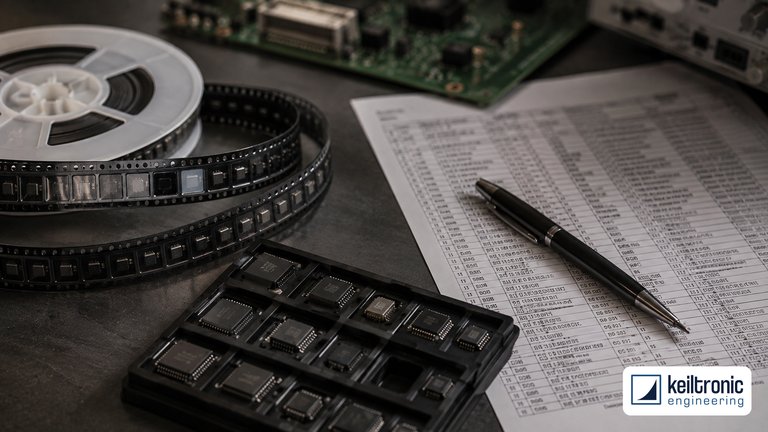
What a discontinuation sets in motion
It starts with an unremarkable letter: a product discontinuation notice with a deadline for the last order. If the affected part is a resistor, nobody loses sleep. If it is the microcontroller, the radio module or a special-purpose analogue part, a small redevelopment begins behind the unchanged front panel: the circuit section is redesigned, the layout changed, the firmware adapted — and because a layout change can change emission behaviour, the device belongs back on the EMC bench afterwards. Add new production documents, and the upkeep of two build states for as long as old and new are manufactured in parallel.
For the manufacturer's customers it remains "the same device". The sameness is paid for in engineering work — and in time nobody budgeted for, if the bill of materials was never checked against the discontinuation notices.
This is not theory for us: as this article is being written, exactly such a case is on our desk — a central component of a series we support is no longer orderable, and the move to an alternative part is being planned. Schematics, layout and firmware will all be touched.
Selection at design time: what we pay attention to
The case cannot be prevented entirely — every component dies eventually. But the design phase decides whether a discontinuation becomes a swap or a project:
- Take longevity programmes seriously. Many manufacturers run industrial derivatives with committed availability — they are preferable to the consumer part, even where the consumer part is cheaper.
- "Not recommended for new designs" is a stop sign. Whoever ignores that note at design time is ordering the redesign along with the part.
- Second source or pin-compatible alternative from the start. Not possible for every part — but where it exists, it belongs in the bill of materials before it is needed.
- Mark the single-source positions. The critical lines of a bill of materials are the ones with exactly one manufacturer. Knowing them is half the contingency plan.
If it happens anyway: a new edition, not a new development
For devices in the field, the proven path is a new edition: circuit and layout moved to available components, the firmware carried over, the production state documented — for your customers the device stays the same, only its insides are orderable again. A last-time buy can bridge the gap until then; it is not a solution: it ties up capital, and stored components age too, down to their solderability.
And in your case?
Do you know which positions in your bill of materials have exactly one source — and when someone last checked the list against the manufacturers' discontinuation notices? Write to us — we are curious how you learn about a discontinuation today: through the manufacturer's notice, or only through your assembly house.
Transparency note: This article was written with the help of artificial intelligence and reviewed by the author before publication. The review applies to the German original; this English version is a translation.