
Blog · August 7, 2026
A dedicated base station: why some devices should not go online themselves
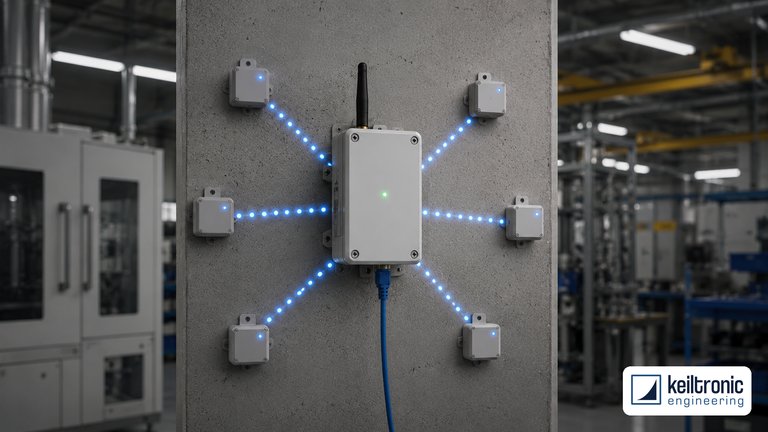
When a device is supposed to deliver data, the reflex is obvious: put a cellular module or Wi-Fi inside, and it talks to the backend itself. For a portable clinical device we decided differently — and developed the base station along with it: Ethernet to the internet, Bluetooth Low Energy to the devices. It reads the devices out and distributes firmware updates. Why the detour?
Three reasons against the direct connection
The energy budget. A wearable or battery-powered device pays for every radio minute out of its battery — and cellular is expensive, BLE is cheap. If the counterpart hangs a few metres away instead of at the nearest cell tower, the biggest item in the energy budget shrinks. The base station, in turn, hangs on a wall socket and can afford Ethernet.
Device cost times fleet size. A radio module plus a contract in every device multiplies with every unit shipped. One station per site serves many devices — and the calculation tips more clearly the more devices work in the same place.
Somebody else's infrastructure. Whoever wants to use the customer's Wi-Fi makes their own commissioning dependent on somebody else's IT — credentials, approvals, changes nobody announces. A dedicated link between device and station makes the installation plannable: the only interface to the building's infrastructure is the station's network socket.
What quietly makes the station the central point
Once the station is in place, it becomes the natural hub: it reads the devices out, it knows their state — and it distributes new firmware to the fleet without any single device ever being directly on the internet. For devices that live in pockets, on walls or on the body, that is the update path with the least effort per device.
The honest price
The base station is not a free win: it is a second device that wants to be designed, tested, manufactured and maintained over years — with its own firmware, its own update path, its own spare-parts question. Its range has to match the site, and if it fails, it is not one device that stops but the site's hub. Whoever chooses this architecture chooses that responsibility with it.
When to choose which way
As a rule of thumb from having built both: few, scattered devices — say, one sensor per site spread across the country — argue for cellular directly in the device; a station per site never pays off there. Many devices in the same place, battery- or body-worn on top, argue for the dedicated base station. The decision comes down to two questions: how often and how much do the devices transmit — and how many of them work at the same site? Not to gut feeling.
What about you?
Does your device talk to the network itself — and if so, because it was the best architecture, or because it was the reflex? Write to us — we are curious how many of your devices work at the same site.
Transparency note: This article was written with the help of artificial intelligence and reviewed by the author before publication. The review applies to the German original; this English version is a translation.