
Blog · August 7, 2026
Why we do not design antennas — and still ship radio devices
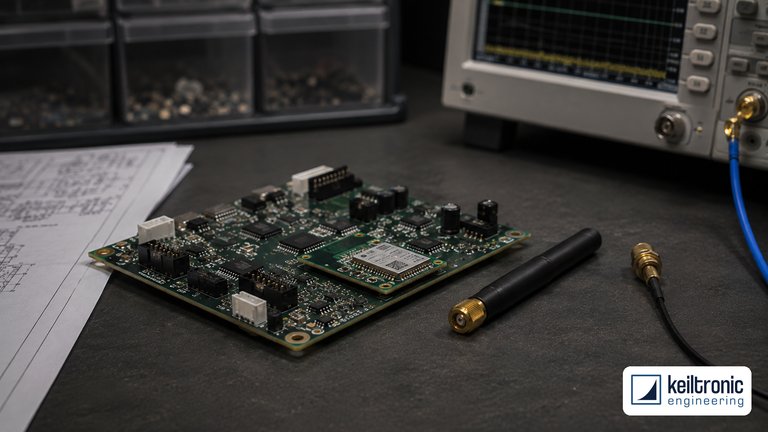
A question from customer conversations that deserves an honest answer: "Do you design the antenna too?" No — on purpose. Our devices use Bluetooth, BLE, NB-IoT and LTE-M, and we have taken radio devices into series production. But the radio-frequency design itself — antenna, matching network, radio front end — we buy in as a proven module. That is not a gap we hide; it is a decision we can explain.
What an RF design of your own really costs
Above a few hundred megahertz, a circuit board stops being a collection of connections and becomes a component itself: every trace length, every layer stack, every neighbouring piece of metal plays along. An antenna design of your own means tuning cycles with measurement equipment far beyond an electronics lab, iterations on the housing prototype, and a result that can shift again with every mechanical change. Module manufacturers do exactly this work once — for all their customers, with their own measurement chamber, at volumes that carry the effort.
What the module takes off your hands — and what it leaves us
A proven radio module brings the tuned radio section with it. What it does not bring is a working device — and that is exactly where our work lies:
- Integration on the board: placement, ground plane and routing to the manufacturer's guidelines — a good module can be integrated badly, and then it radiates badly.
- The energy behaviour: in battery devices it is not the radio technology that decides the runtime but how often and how long it transmits — the protocol and the payload are the lever.
- The update path and the connection: what runs over the radio link — measurements, parameters, firmware — is systems engineering, not an antenna topic.
- EMC pre-compliance: even a device with a module must be electromagnetically compatible as a whole — measured in our own shielded tent, before it gets expensive.
The boundary stays honest
There are projects that need a tailor-made radio design: extreme miniaturisation, special frequencies, antennas inside metal housings. For those we are not the right partner — we say so in the intro call, not in month three. Not out of distance to the subject, by the way: high-frequency engineering was a focus of the degree behind this firm. Which is precisely why the module decision is one of respect for the effort — not one of fear of the physics.
What about you?
Is there a radio module in your device, or a radio design of your own — and do you still know why? Write to us — we are curious where the radio link last caused you trouble: in the design, or in operation.
Transparency note: This article was written with the help of artificial intelligence and reviewed by the author before publication. The review applies to the German original; this English version is a translation.